

History of Deped Tayabas
The City Schools Division was established pursuant to Sec. 49 of RA 9398 also known as “An
Act Converting the Municipality of Tayabas in the Province of Quezon into a Component City to be known as City of Tayabas”.
Through the initiative of Dr. Tolentino Aquino, Schools Division Superintendent of
Quezon Province and Dr. Lorna Dig Dino, Regional Director of Region IV-A CALABARZON, the separation of the City Schools Division of Tayabas from DepEd Quezon was initiated.
DepEd Secretary BR. ARMIN A. LUISTRO, FSC, issued a memorandum authorizing the establishment of the City Schools Division of City of Tayabas on September 26, 2012.
After barely a month on October 29, 2012, Secretary Luistro designated EDNA FAURA-AGUSTIN as the OIC-Schools Division Superintendent of the newly-established City Schools Division.
To formally start the operation as a city division, Agustin formed an organic staff that included Dr. Gener C. delos Reyes Special Assistant to the SDS, Mrs. Angeles Baer OIC-Administrative Officer V, Mrs. Ma. Concepcion Moreno OIC-HRMO I, Mrs. Ma. Corazon Borbon OIC-Planning Officer II and ICT Coordinator, Mrs. Racel J. Romero OIC-Cashier II, Mrs. Teresa Palma OIC-Supply Officer II, Mrs. Susana Piquero OIC-bookkeeper and Mrs. Marife Lagar Office Personnel.
The designated Division Education Program Coordinators are Mrs. Mildred Z. Galleno ALS, Mrs. Imelda C. Raymundo Filipino and SPED, Mrs. Cleotilde B. Abordo Values Education, Mrs. Cecilia R. Pingol Science and Research, Dr. Felisa C. Zalameda TLE, Mr. Sherwin C. Quesea MAPEH, Mrs. Fideliza V. Luces AP, Mr. Enriqueto F. Tabernilla English , Mr. Nonilon Z. Nadal Mathematics and Dr. Edwin R. Rodriguez SBM and K-12 Coordinator and later as Special Assistant to the SDS.
A Memorandum of Agreement was signed by Mayor Faustino Silang and Sec. Armin Luistro on February 15, 2013. Dr. Dino and Dr. Tolentino Aquino served as witnesses.
The legitimate division personnel assumed their duties and responsibilities on July 1, 2013.They are Mr. Conrado C. Gabarda Administrative Officer V, Mrs. Josefina R. Oabel HRMO I, Mrs. Agnes M. Luzadas Accountant II, Mrs. Amparo R. Masajo Cashier II, Mr. Benjamin A. Millares Supply Officer II, Mrs. Marife R. Lagar Planning Officer II, Mrs. and Dianah G. Tan Administrative Aide IV.
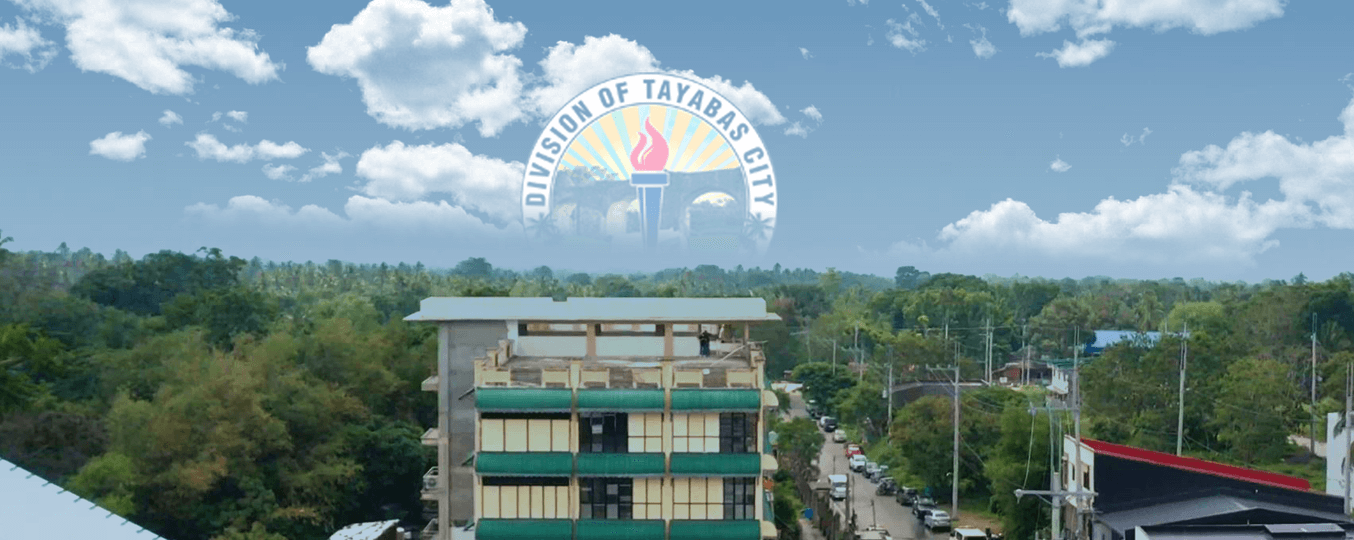
Presently, the City Schools Division has its office address at Brgy, Potol, City of Tayabas.
SDO Tayabas City, an ISO 2015 Certified Public Institution continuously improves itself to better service
Quotes
We are a community of leaders at SDO Deped Tayabas. We appreciate, celebrate, and honor the leaders we have.
Creativity grows when learning has a purpose. Thinking emerges when creativity flourishes. Knowledge is completely lit when thinking arises. The economy thrives when information is unleashed.
DepEd Tayabas March
HISTORY OF TAYABAS
In 1578, Fray Juan de Plasencia and Fray Diego de Oropesa, two Franciscan missionaries from Spain founded the town of Tayabas in order to spread Christianity to its natives. Prior to the occupation, however, the native Tayabenses lived in rural settings typical to those times, with barangays headed by village chiefs and councils of elders.
From 1749 to 1901, Tayabas was the capital of the Province of Tayabas, now known as Quezon. In the 19th century, Tayabas was among the biggest towns in the country. Its Minor Basilica of St. Michael the Archangel, which was enlarged in the mid-1850s, is the longest church in the country and is a lasting testament to its glorious and historic past.
In more than three centuries of Spanish occupation, only eight cities and towns were given the title of Villa, and Tayabas was one of them. These are La Villa del Santisimo Nombre de Jesus de Cebu in 1565, La Villa de Santiago de Libon (Albay, 1573), La Villa Fernandina de Vigan (Ilocos, 1574), La Villa Rica de Arevalo (Iloilo, 1581), La Noble Villa de Pila (Laguna, 1610), La Muy Noble Villa de Tayabas, (Tayabas, 1703), La Villa de Bacolor (Pampanga, 1765), La Villa de Lipa (Batangas, 1887). Interestingly, that Tayabas was given the title of ‘most noble’ villa even before it became the provincial capital shows its importance even before 1749.
In the book “The Philippines,” written by French traveler Jean Baptiste Mallat, and published in 1846, it appears that Tayabas had more than 21,000 people at that time. This was reduced to 16,000 when Lucena became an independent town in 1879. Due to low population growth during the Spanish period, this number remained unchanged until the coming of the Americans.
Tayabas is at the center of the province’s long-settled heartland, which possessed the best lands, the oldest parishes, and the most active commercial centers. The provincial heartland was described by Pres. Manuel L. Quezon as having the “richest and gayest places in the province.”
Tayabas has many places of interest. Its Casa Comunidad, a centuries-old building, is the place where Apolinario “Hermano Pule” Dela Cruz was tried and sentenced to death in 1841. It was restored in the 1990s through funds donated by the “Friends of Casa Comunidad,” an organization of affluent Manila-based Tayabenses.
Its numerous Spanish-era bridges mirror its rich architectural past. Two of the longest are the Malagonlong and the Malaoa bridges. Malagonlong’s high and beautiful arches and its solid design are some of the reasons why it was declared a national historical site. It is so strong that it withstood the dynamites planted there to stop the Japanese advance during World War II.
Tayabas suffered a terrible blow near the end of World War II when it was completely burned to the ground after a bombing raid on March 15, 1945. Prior to that, the old houses of Tayabas rival those of Vigan’s Spanish-era structures.